0 224 443 23 18
 info@teknokol.com


 TR
 EN
 IT
 DE
 RU
 CZ

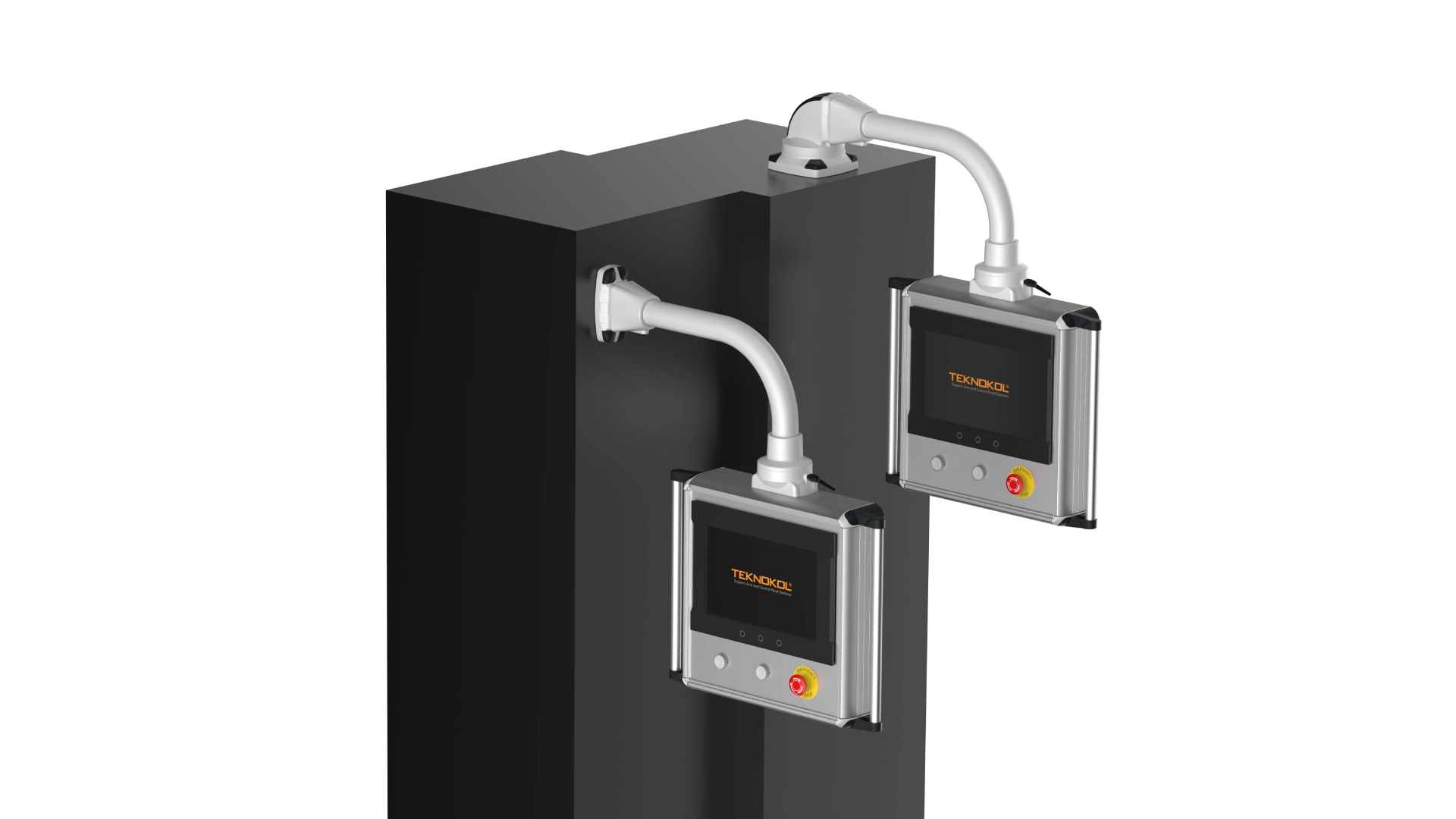
A More Economical Alternative with Steel Tube Profile
Positioning control panels on industrial machines is an important issue for operator ergonomics, ease of use, and production efficiency. Support arm systems ensure that control panels are connected to the machine safely and functionally.
However, not every application has the same requirements. There are significant engineering and cost differences between carrying large, heavy control panels over long distances and positioning small, lightweight control panels over short distances.
So, is it always necessary to use a multi-part, modular aluminum support arm system for short-distance, lightweight applications?
Perhaps a much simpler solution is enough for some applications: support arms made from bent steel tube profile.
Aluminum Support Arm Systems: Modularity and High Load Capacity
Aluminum support arm systems provide significant advantages thanks to the flexibility, modular structure, and connection options they offer when positioning industrial control panels.
In particular, aluminum profile systems are a strong solution for:
- Heavy and large-sized control panels
- Long-distance support arm applications
- Systems that require positioning at different angles and positions
- Applications that require rotating, tiltable, and different connection modules
- High load capacity and modular expansion requirements
Teknokol's TK120 series was developed for heavy, long-distance applications with a load capacity of 120 kg per meter. The TK060 series is designed for medium-weight control panels with an average load capacity of 60 kg per meter.
In addition, the TK045 series is a more compact aluminum support arm option developed for light-load, short-distance applications.
Aluminum systems therefore offer a wide solution family that can be scaled to different application needs.
But Modularity Is Not Always Necessary
When evaluating a control panel's support arm needs, it is important to look not only at load capacity but also at the application's actual requirements.
For example, if:
- The control panel is small and light
- The support arm distance is short
- The panel will be positioned at a fixed angle
- No rotating or tiltable connection modules are needed
- Numerous intermediate connection parts are not required
Then a modular aluminum support arm system can become a more extensive solution than the application actually needs.
The aim here is not to question the advantages of aluminum systems, but to correctly match the complexity of the system used to what the application actually requires.
Because sometimes fewer components mean less assembly time and a lower total cost.
Support Arm Bent from Steel Tube Profile: A Leaner Design Approach
One alternative worth considering for short-distance, lightweight control panels is a support arm design created by bending a steel tube profile of suitable diameter and wall thickness into the required geometry.
With this approach, instead of a multi-part modular system, a single-piece or low-part-count support construction can be created wherever possible.
By bending the steel tube profile:
- The support arm's geometry can be designed specifically for the application.
- Unnecessary intermediate connection parts can be reduced.
- Connections that require assembling multiple modules can be eliminated.
- A leaner product can be achieved with fewer parts.
- Production and assembly costs can be optimized with designs suitable for series production.
Furthermore, this approach can also provide design freedom in certain machine applications that require non-standard geometries.
The important point here is that the steel tube is not simply bent and used as-is; it is designed as a complete support system together with connection points, mounting plates, welding details, and surface treatments.
Fewer Parts, Less Assembly, Lower Total Cost
When evaluating the economic advantage of a new support arm solution, it is not enough to look only at the raw material cost of the profile.
What really matters is the total system cost.
In a modular system, different connection modules, adapters, fasteners, and assembly operations may also be included in the cost alongside the profile itself.
In a bent steel tube profile solution, depending on the design, some of these components can be reduced.
The main differences between the two approaches can be evaluated as follows:
| Evaluation | Modular Aluminum System | Bent Steel Tube System |
| Structure | Multi-component | Single-piece or low part count |
| Connection | Modular connection parts | Direct mounting plates |
| Assembly | Joining of multiple modules | Fewer assembly steps |
| Design | Flexible configuration with standard modules | Application-specific geometry |
| Cost approach | Modularity and functional variety | Simplicity and part reduction |
| Field of use | Wide range of solutions for different loads and distances | Suitable for short-distance, light-load applications |
This comparison should not be read as a claim that the steel tube solution is more economical under all conditions. Factors such as bending, welding, surface coating, special fixtures, and production quantity also affect cost.
However, in the right application, reducing the number of parts and assembly operations can create a significant cost advantage.
Engineering Criteria to Consider in the Design
A support arm made from steel tube profile must be not only economical but also safe and long-lasting.
For this reason, some key criteria should be evaluated at the design stage:
Load capacity
The weight of the control panel, the length of the support arm, and the position of the center of gravity must be evaluated together.
Deflection and rigidity
Tube diameter, wall thickness, material quality, and bend geometry determine how much the support arm will flex under load.
Connection safety
The points connected to the machine and the control panel must be designed to withstand the static and dynamic loads that may occur during operation.
Surface protection
An appropriate paint or coating system should be selected based on the conditions of the environment in which the steel material will be used.
Ergonomics and usage
Positioning the control panel correctly from the operator's perspective, as well as accessibility and any movement requirements, should be included in the design.
A tube-profile support arm developed in line with these criteria can provide a functional alternative, free of unnecessary complexity.
A Different Solution Area for Teknokol: A Support Arm Suited to the Need
Teknokol's support arm product family is built on aluminum profile systems that respond to different weight and distance requirements.
However, in the industrial market, not every customer has the same needs.
Some machine manufacturers may look for a more economical, lower-part-count, and quickly assembled solution for carrying small control panels over a short distance in a fixed position.
At this point, the approach of a support arm bent from steel tube profile can be considered a different product category that could expand Teknokol's range of products and solutions.
Moreover, this approach can be positioned not so much as an alternative to existing aluminum systems, but as a complement to them.
While aluminum systems such as TK120 can be used for large, heavy panels, TK060 for medium-scale applications, and TK045 for light, short-distance applications, a leaner support solution made from bent steel tube profile can be preferred for certain fixed, simple applications.
Conclusion: The Best Support Arm Is the One Best Suited to the Need
In industrial design, more modules, more connections, or higher capacity do not always mean a better solution.
What matters is correctly analyzing the application's actual needs and developing the most suitable engineering solution.
Modular aluminum support arm systems will continue to offer significant advantages in applications that require long distances, heavy loads, and different movement capabilities.
In contrast, for short-distance, lightweight, and fixed-position control panels, support arms made from bent steel tube profile can be an alternative that provides fewer components, easier assembly, and a lower total cost under suitable production conditions.
Because true engineering is not about offering the most comprehensive system for every need, but about designing the most correct system for every need.
At Teknokol, evaluating different application needs in support arm solutions and determining the most suitable system for industrial control panels is an important part of efficient and economical machine design.